Delivering critical care without boundaries
For a critically ill patient in a rural hospital, the physician helping direct their care may be hundreds — or even thousands — of miles away.
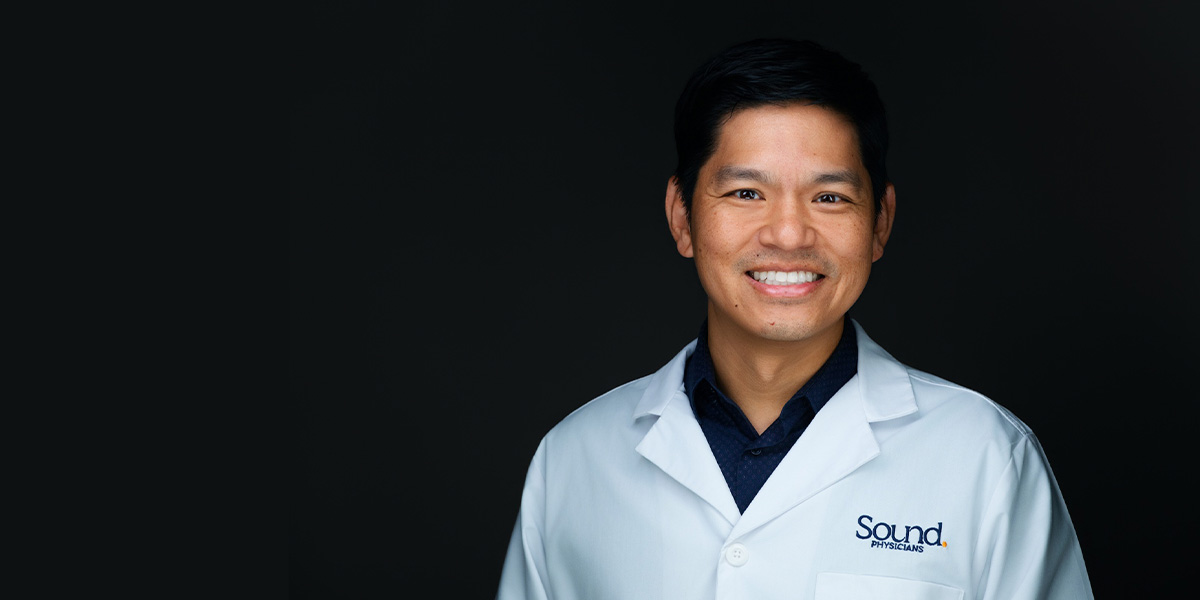
Eugene Yeh, M.D. ('09), knows that scenario well.
As a critical care physician and program medical director with Sound Physicians, Dr. Yeh provides telecritical care to hospitals across the country, using technology to bring intensive care expertise to communities that may otherwise struggle to recruit or maintain around-the-clock critical care specialists.
The physician may be virtual, but much of the care looks remarkably similar to what happens in a traditional intensive care unit.
“We're talking to the patient, we're reviewing labs in real time, we're writing the charting and notes just like we're there,” Dr. Yeh said. “We're putting in orders [and] discussing the plan of care with the nursing [team].”
What Dr. Yeh can't do remotely — perform a procedure or physically examine a patient, for example — is handled by the physicians, nurses and other clinicians at the bedside. Together, they form a team that allows more patients to receive specialized critical care without necessarily leaving their community.
Bringing expertise to the patient
For hospitals in rural or underserved areas, recruiting critical care physicians can be difficult. Telecritical care offers another option: bring the specialist to the patient virtually.
Dr. Yeh has seen hospitals use the model to strengthen their ICU services and care for patients who might otherwise need to be transferred to larger medical centers.
That can have implications beyond the medical care itself. Keeping a patient closer to home can also keep families and support systems nearby during what may be one of the most difficult periods of their lives.
And rather than waiting for a crisis before calling a remote specialist, Yeh advocates for a proactive model in which the telecritical care physician becomes an integrated part of the ICU team.
His recent research offers an indication of what that approach can accomplish.
Measuring the impact
Dr. Yeh and his colleagues studied the implementation of a proactive, 24/7 telecritical care model in a rural Midwestern ICU. Board-certified telecritical care specialists co-managed critically ill patients, rounded daily, documented in the medical record, entered orders and participated in multidisciplinary rounds.
The team examined outcomes for 537 patients seen by telecritical care specialists between January 2023 and January 2025.
In the two years following implementation, average ICU length of stay decreased by 14%, from 2.2 to 1.9 days per patient. Average time on mechanical ventilation decreased by 35%, from 2.87 to 1.89 days per patient. ICU readmissions decreased by 43%, from 5.13% to 2.94%.
Dr. Yeh presented the findings at the Society of Critical Care Medicine's 2026 Critical Care Congress.
“We wanted to show the world what we can do,” Dr. Yeh said.
For Dr. Yeh, demonstrating outcomes is important as telecritical care continues to evolve. The findings suggest that the model and, importantly, the way it is implemented may influence its effectiveness. The researchers characterize the study as hypothesis-generating, opening the door for continued research into how telecritical care can improve ICU efficiency and patient outcomes.
Finding his path to critical care
Dr. Yeh's path to the virtual ICU began in a decidedly traditional place: his clinical rotations at NEOMED.
He was drawn to the intensity of critical care — the fast pace, emergencies and opportunity to care for some of medicine's sickest patients. After graduating from NEOMED in 2009, he continued his training and ultimately built a career in pulmonary and critical care medicine.
Years later, a combination of professional curiosity and changing priorities at home led him toward telecritical care.
By 2022, Dr. Yeh and his wife, who is also a physician, had two sons and were expecting their third child. He began thinking about how he could continue practicing the medicine he loved while gaining greater flexibility for his growing family.
Then a colleague left for a tele-ICU position.
Dr. Yeh saw an opportunity to practice critical care differently — and took it.
The move ultimately became more than a change in where he practiced medicine. It gave him an opportunity to think differently about how critical care itself could be delivered.
From clinician to leader
Today, Dr. Yeh's role extends beyond seeing patients remotely.
As a program medical director, he helps develop and manage telecritical care programs, working through the many pieces necessary to successfully integrate a remote intensivist into a hospital's existing care team.
That can mean considering technology and equipment, documentation, nursing workflows, order sets and how telecritical care physicians interact with the clinicians physically caring for patients.
It's a distinction reflected in Dr. Yeh's research. Simply having telecritical care available may not be enough; how the model is incorporated into patient care matters.
For Dr. Yeh, that work has also represented an evolution in his own career — from treating the patient in front of him to helping design systems capable of improving care for many more patients.
Looking toward the next evolution
Telecritical care itself continues to change.
Dr. Yeh sees potential for hybrid models that combine on-site and virtual intensivists, greater use of telecritical care expertise in emergency departments and new technologies that make remote care more efficient.
Artificial intelligence may be part of that evolution, too, from assisting with clinical documentation to helping physicians more efficiently access and apply medical information.
“I think a lot of us are afraid of AI, but I think in medicine, there's a real opportunity for AI to help physicians provide better care,” Dr. Yeh said.
His interest in what's next reflects a lesson that has stayed with him since his medical training.
While at Cedars-Sinai, Dr. Yeh watched the hospital transition from paper charts to the Epic electronic medical record. He remembers an older physician who could have resisted the change. Instead, the physician took typing classes and sought additional instruction to learn the new technology.
For Dr. Yeh, it became an example of the adaptability medicine demands.
“We can't be stagnant when we're in this field,” he said. “You kind of have to keep on evolving and keep on trying to see, what else can I learn?”
More than 15 years after graduating from NEOMED, Dr. Yeh is putting that philosophy into practice — embracing new ways to deliver critical care while helping ensure that geography doesn't have to stand between patients and the expertise they need.
Want to learn more about telecritical care and what it's like to practice medicine from a virtual ICU? Hear more from Dr. Yeh in the Healthcare Musings podcast episode, “A Day in the Life: Telecritical Care With Dr. Eugene Yeh.”
- submitted by Department of Alumni Relations