Exploring the root causes of declining breast cancer screenings at two local clinics
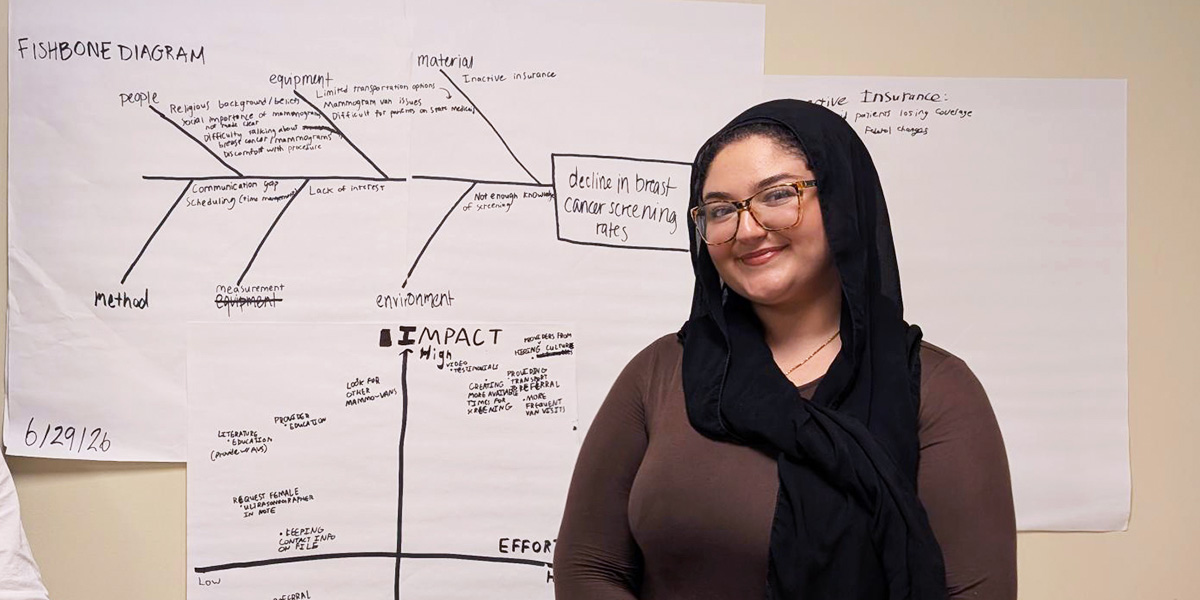
The International Community Health Center (ICHC), a federally qualified health center in Akron and Cleveland, was seeing a decline in breast cancer screenings among their patients. Amy Lee, M.D., M.P.H., professor of family and community medicine and program director of the Consortium of Eastern Ohio Master of Public Health, designed a project to find out why the decline was happening and what could be done about it.
Second-year medical student Leena Dughly was a Summer Research Fellow on the project, analyzing the ICHC data on breast cancer screenings and exploring high-impact, low-effort interventions to address the issue.
She shared her experience with The Pulse.
What was the purpose of the project?
The purpose of this project was essentially to facilitate an investigation into declining breast cancer screening rates at the International Community Health Center (ICHC) and develop a data-driven quality-improvement plan to address them.
Can you give a brief description of the project and your role in?
This project is a part of the NEOMED summer fellowship. Working under Dr. Amy Lee, I have conducted root cause analyses (RCA) sessions at ICHC’s Cleveland and Akron sites, where I have been using structured QI methodology, fishbone diagrams, Five Whys analyses and impact/effort matrices, to identify why screening rates dropped and prioritize interventions ICHC can realistically implement. Using these tools, we aim to guide ICHC to the preventions that provide the greatest possible patient impact and satisfaction while being realistic for the clinics.
 What led you to choose this project? How does it align with your career goals?
As of right now, I would say I’m most interested in going into OB/GYN, with potentially a focus on reproductive health and oncology, so a project centered on breast cancer screening was truly a natural fit. But what really drew me to it was the population ICHC serves. I'm passionate about improving access to care for immigrant and refugee communities, groups whose health outcomes are too often overlooked or deprioritized. Screening disparities are exactly where that gets played out: if a community isn't getting screened at the same rate as everyone else, it's usually not because people don't care about their health, it's because something in the system, like transportation, insurance, language, trust, is getting in the way. I wanted to work on a project that took that seriously and tried to name the actual barriers instead of assuming what the problem is on behalf of the patient. It's given me a much clearer picture of what it looks like to build care systems around the patients who are hardest to reach, which is exactly the kind of practice I want to build my career around.
Breast cancer screenings went down at ICHC over the last couple years. Did this project look at reasons why that happened? If so, what were some of those reasons?
Yes and we accomplished this within the root cause analyses sessions at each site. The two sites interestingly showed different patterns. At the Cleveland site, the largest cluster of causes was patient-level, like declining the screening, not following up upon referral or difficulty with navigating screening sites. At the Akron site, causes clustered around three broader categories: logistical/access barriers, communication gaps, and social or cultural factors that impact the appointment experience. Both sites also noted inactive insurance coverage and changing policies as contributing factors.
Are you putting together a proposed action plan for ICHC to address the issue? Are you able to share any of the proposed steps?
I am in the process of that right now! I have written out summaries of our RCA sessions with their suggested interventions, as well as digitized the various diagrams that were created in the process of the project. Right now, I am working on combining these summaries to formulate interventions that can be implemented within both clinics and each individually if necessary.
What are some key takeaways for you from this project?
The staff's input on the causes behind declining screening rates was absolutely invaluable to this project. If I'm honest, my biggest takeaway isn't really about the project itself, it's about the people who showed up for it. The staff who work closest to patients are the real driving force behind this kind of work. They gave their time to sit with us, walk through what they were seeing and help us understand what's actually affecting the population they serve. Without that willingness, none of the root causes we identified would have been identified.
Anything else you’d like to add?
Along with creating the proposed action plan for ICHC, I plan on submitting an abstract to present my findings at the NEOMED Student Research Symposium. I would like to continue working with the ICHC in the future. Together we also discussed ways to expand their reach in the community and I expressed interest in continuing on with them in some capacity.
Related
Want to learn how to use tools like structured QI methodology, fishbone diagrams, Five Whys analyses and impact/effort matrices in your work? A new cohort is forming for the Lean Six Sigma Yellow Belt at NEOMED. Learn more.