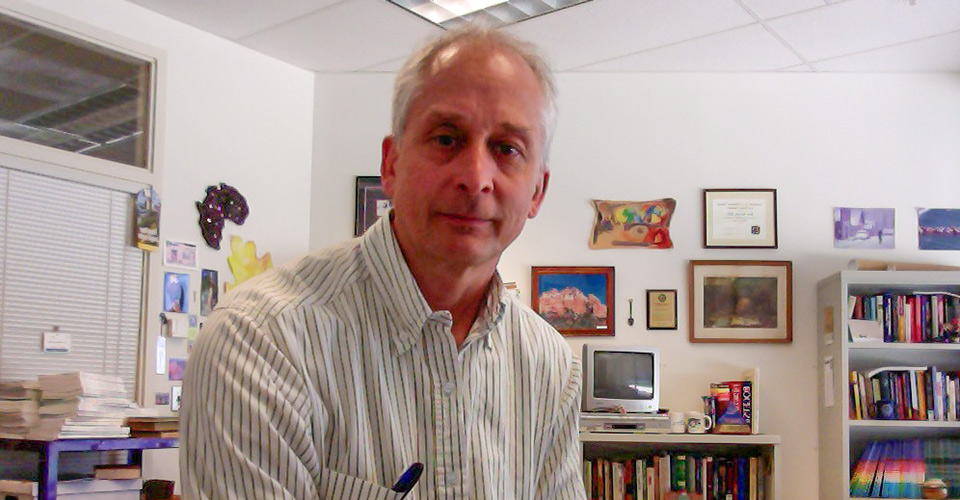
Celebrating our 50th: Get to know Paul Hartung, Ph.D.
As part of our 50th anniversary celebration, The Pulse has reached out to several long-time employees to share their stories, experiences and memories as NEOMED has continued to grow. Paul Hartung, Ph.D., professor in the Department of Family and Community Medicine, joined NEOMED in 1990. Below, he recalls his early days at NEOMED, his unforgettable mentors and a moment that to this day makes him laugh.

When did you start at NEOMED?
I enjoyed two starts. In August 1990 I began work as a graduate assistant until 1992. In July 1994, I returned as assistant professor of behavioral sciences.
 What was your first role at the University? Subsequent role or roles? Current role?
Graduate assistant was first, followed by faculty member. Of note, I have enjoyed the honor of serving as a course director for every medical student class since 1995. For the past 3 years I served as vice-chair and now serve as interim co-chair for the Department of Family and Community Medicine.
What led you to NEOMED?
Good fortune and great opportunity. Don Bubenzer, chair of the Kent State University Department of Counseling recommended me to Mark Savickas, chair of the Department of Behavioral Sciences, for the graduate assistant position. In 1993 while living and working in Connecticut, I received a call from Mark recruiting me back to NEOUCOM for the position of assistant professor.
What do you remember about your first day or week or month at NEOMED?
Memory of my 1990 start is fuzzy. I do remember walking in to work my first day in 1994 carrying boxes of books and other materials. Jeff Wenstrup approached, introduced himself, and offered me a hearty welcome and helping hand. I never forgot that.
What is your favorite NEOMED tradition? Why?
Commencement and employee recognition days prove ongoing annual favorites. I believe it has faded, but the once annual talent show displayed students’ enormous musical, performance and entertainment abilities and provided a much-needed outlet for them to relax near the end of a grueling academic year. These shows proved invariably spirited and sometimes raucous back in the day, including the trenchant yet always tasteful lampooning of faculty. Once a beautiful and interesting courtyard feature, a medicinal herb garden opened to the NEOMED community every fall for harvesting.
Besides the most visible changes – such as adding a College of Pharmacy or changing the name from NEOUCOM – what are some of the most impactful changes you’ve seen over the years at NEOMED?
 All changes over the years fundamentally derive from the people who animate and enliven NEOMED. Of course, the entire campus has grown to include housing, a high school, facilities and programs available to the surrounding communities, a relocated and rebuilt Wasson Center and Nook bookstore, an emerging dental school, and on and on. Everything that has come with growing the campus, adding colleges, and developing new programs has had the greatest impact during my time. And with every change, we carry on.
Are there any changes that had particular meaning for you? What and in what way?
In 2009 we moved from Lower E to Lower G building to join colleagues in Community Health Sciences and, in 2011, Family Medicine to form our current department. This move proved bittersweet as it ended our three former individual departments yet offered opportunity to consolidate our personnel and programs for increased synergy.
What is your favorite place on the NEOMED campus that did not exist when you started?
The NEW Center offers a beautiful entry and gathering space that joins NEOMED and surrounding community members alike. While it existed when I arrived, the campus central courtyard remains a favorite place.
Who is one (or some) of your biggest mentors during your time at NEOMED? How did they impact your career?
Ansel Woldt, Kent State University professor, provided the initial support, guidance, and wisdom to help me navigate my graduate studies and launch my post-graduate career. Mark Savickas took it from there. Mark has said we learn half of everything we know in life by age 8. I say I learned the other half when I met Mark. In ways immeasurable I owe my life and career in large part to Mark. And Glenn Saltzman gave me the sage advice “If you want to be a star, do everything you say will do. If you want to be a superstar, do it early!”
What’s your best, most touching or funniest NEOMED story?
Long ago we provided the M1 class with the course syllabus amounting to a hefty book. Delivering the syllabi to then 105 medical students required loading them (the syllabi not the students) onto a cart for wheeling from Lower E to Olson Auditorium. This task required using an elevator and fell to our graduate assistant (GA) who we soon learned lived with elevatophobia. Not to worry! The GA simply engaged the elevator up button, waited for the doors to open, thrust in the cart, pushed the second floor button, ran upstairs to the opening elevator doors, removed the cart, and traversed the hallways of upper E, D, C, and B buildings to arrive at the upstairs auditorium entrance. Job well done! (N.b. – Exposure therapy helps with phobias.)
How has the field changed since you started at NEOMED? Give one or two examples.
21st century globalization and digitalization have revolutionized our world; destabilizing work, workplaces and workers. In response, a major shift in vocational psychology and career development has involved developing and using narrative models and methods to promote human life-careers. Research and practice efforts indicate that knowing your life story holds and carries you through times of career transition and uncertainty; including in times of stress and strain when it gets confusing to make career decisions or feels like work won’t love you back. Ultimately, the most important story is the one you write and tell yourself. And every life is worth a novel.
Anything else you’d like to add?
In his 1994 letter offering faculty appointment, Dr. Blacklow welcomed me “as part of the NEOUCOM family.” And a family it has remained these many years. Knowing our NEOMED family history is critical to our school’s present and future success; like knowing your personal family history promotes your own health and well-being (see examples here and here). NEOMED is a great place with great people doing great work and great things. Thank you for the opportunity to provide a bit of my voice to our shared history.