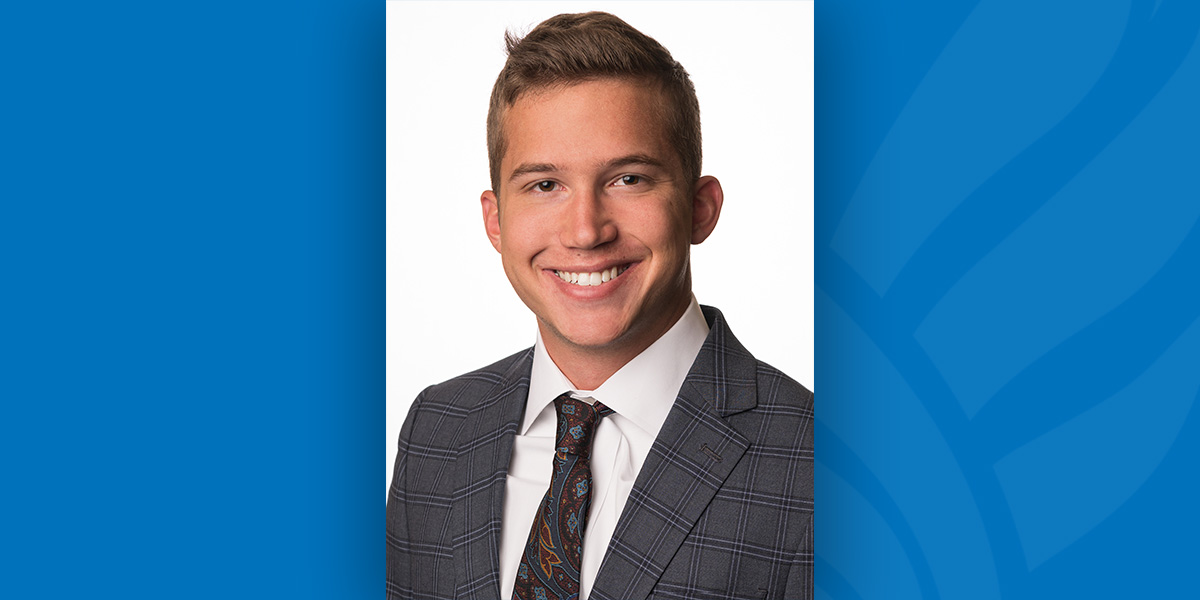
Medical student earns spot at international pediatric transplant congress
Congratulations to third-year medical student Zachary Oatley, who received the CareDx Congress Scientific Award to attend the 2025 Congress of the International Pediatric Transplant Association in Berlin, Germany, in September.
Oatley received the award for his research on “Tolerating unfavorable donor criteria in pediatric kidney transplantation: A retrospective UNOS analysis.”
Oatley is returning to NEOMED for this third year in the College of Medicine, following a research year under the mentorship of Fayez Safadi, Ph.D., Ohio Research Scholar and professor of biomedical sciences at NEOMED, and Rupesh Raina, M.D., at Akron Children’s Hospital. The main goal of his research is to expand the supply for pediatric kidney transplants by expanding donor criteria while maintaining positive outcomes for transplant recipients.
“Looking across a population of nearly every pediatric kidney transplant in the country, we found that recipients from live related donors with numerous significant comorbidities outperform even the healthiest deceased donors,” said Oatley. “Further research alongside careful consideration for donor health could ultimately result in more children receiving kidney transplants.”
In addition to the oral presentation of his work, Oatley will moderate an oral presentation session on considerations for pediatric kidney transplantation and present a poster that characterizes the epidemiology of recurrent glomerular nephritis after kidney transplantation.
Other research interests
Oatley has also been involved in projects related to sleep apnea and bone biology.
Oatley was part of the Dream AI team that won Best in Digital Health recognition at the University of Utah’s Bench to Bedside competition in 2024. Dream AI is a digital health solution for machine-learning-enabled sleep apnea screening. Oatley noted that he has filed a non-provisional patent for the technology.
His work in sleep apnea also gained recognition from the American Academy of Sleep Medicine Foundation, which selected Oatley for a 2025 Trainee Investigator Award. "That may be my proudest achievement of the year considering the size of the organization and that I conducted [the research] independently," he said.
Oatley co-authored a textbook chapter for the upcoming edition of Sleep Apnea and Snoring on the topic of AI-enabled consumer sleep devices. He also completed work as a research coordinator to validate a new AI-enabled home sleep testing device called the Belun Ring at University Hospitals.
In the basic science realm, he has worked in the lab of Dr. Safadi with M.D./Ph.D. student Trinity Kronk. In the lab, he was involved in preclinical research investigating the use of the protein GPNMB and a small peptide derivative of the protein as an intraarticular injection to treat osteoarthritis.
“I really enjoyed this work,” Oatley said. “In an alternate reality, I think I would have really enjoyed pursuing a Ph.D.”
Besides learning about niche clinical topics, Oatley noted that participating in research has helped him learn more about the clinical research landscape, entrepreneurship and machine learning, as well as important life and professional lessons.
“I had numerous great mentors that were all indispensable in achieving any success that I had and navigating various obstacles,” he noted.
He is excited to learned more and in the future play an active role in developments in medicine and AI.
“Much of the work I did this year was enabled by a strong understanding of both medicine and data science and machine learning. In the future, I strongly believe that AI will play a central role in medicine,” he said. “Undoubtedly, this would require knowledgeable workers who are able to integrate both domains. As I come back to medical training, I hope to find ways to maintain and grow my involvement in AI to contribute to this changing future.”
Oatley is humbled by the recognition from IPTA.
“Nobody attending a national or international conference with thousands of people expects to receive an award, even if you are highly experienced,” he said. “This year was my first foray into medical research. For the first award [at Bench to Bedside], I just felt like I got lucky. Maybe that was just imposters syndrome. When I heard about the second award, I could just hardly believe it, but it has been a huge honor, and I am proud to represent NEOMED.”