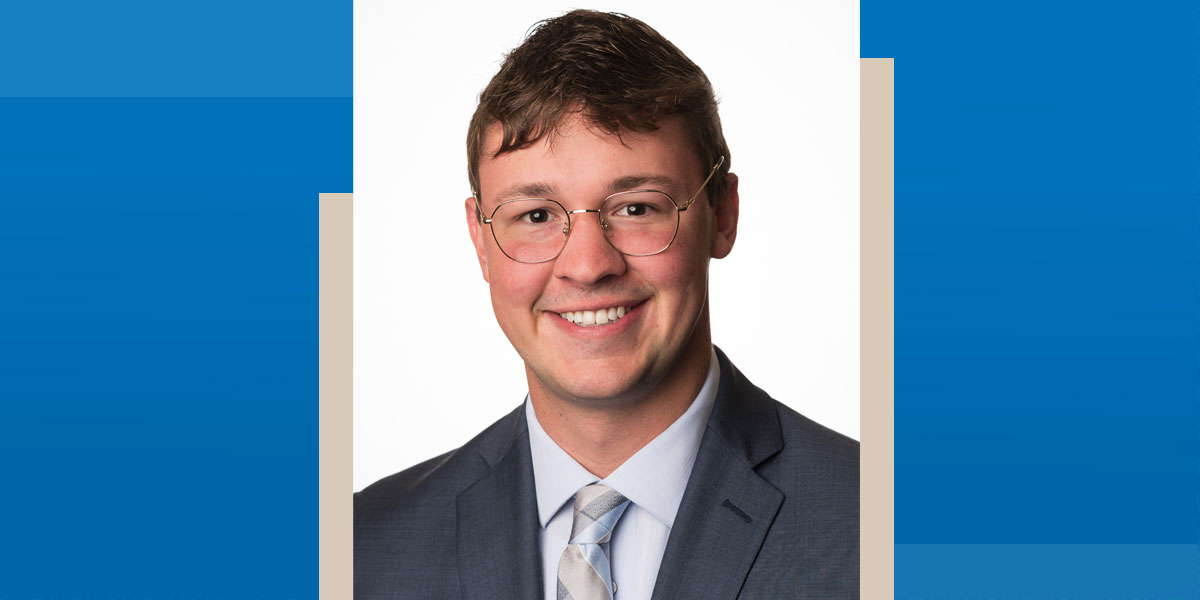
Medical student reflects on national research scholarship
Rising fourth-year medical student Sean Hergenrother recently received a $3,000 research award from the American Academy of Neurology. He has been working with Jeffrey Mellott, Ph.D., on an ongoing study which investigates hearing loss and Alzheimer's disease progression.
The award from AAN is designed for medical students with limited research experience relevant to clinical or neuroscience fields to encourage further interest.
Hergenrother shared his thoughts on the opportunity with The Pulse.
What motivated you to apply for the scholarship?
Working in Dr. Mellott's lab has been a wonderful experience that helped to set me up for success in my residency application and in life. I have grown tremendously in knowledge of the basic science research process, as well as preparing poster presentations and manuscripts since joining the lab. I am fortunate that Dr. Mellott also serves at the faculty advisor for AAN-SIGN (American Academy of Neurology-Student Interest Group in Neurology), through which this scholarship was offered. Applying for this scholarship was a great opportunity to help contribute to the lab while I am off campus for clinical rotations.
Why Alzheimer’s disease and hearing? Is that a particular interest for you? Do you see yourself going into ENT? Or maybe geriatrics or neurology?
Dr. Mellott's lab is unique as few labs nationwide use electron microscopy (EM). EM is the best way to visualize what is happening in a brain at the level of the synapse. Previous studies have shown that hearing loss is a large modifiable risk factor for neurodegeneration. The question we are hoping to elucidate is whether synapses in the hearing center of the brain in a mouse model with Alzheimer's disease are changing in ways reminiscent of changes that occur in hearing loss.
I am hoping to go into neurology! The brain has always fascinated me. I view it as "the final frontier" of medicine since there traditionally has been a paucity of effective treatments over the past decades. Now we have started to see the emergence of highly effective therapies for conditions such as multiple sclerosis, headaches, etc. I truly believe the landscape of treatment for neurologic conditions is changing in part due to the hard work and dedication of labs across the country such as Dr. Mellott's.
Do you see yourself continuing to do research as a physician?
This is a great question! I think research is essential for furthering science and healthcare. However, it would be difficult to find dedicated time for basic science research as a physician, especially without an M.D./Ph.D. degree. I hope to one day lead clinical trials, as they provide potential paths to recovery and hope for patients who have exhausted conventional treatment options.
What are looking forward to most about this experience?
I am just happy to support the lab! With growing uncertainty surrounding scientific research funding, every amount of contribution towards demystifying neurodegeneration helps, so that one day, patient lives will be saved and disease burden lifted.
Anything else you’d like to add?
If you are interested in neurology, there is a wealth of opportunity offered through the AAN, as well as here on campus so please reach out and get involved!