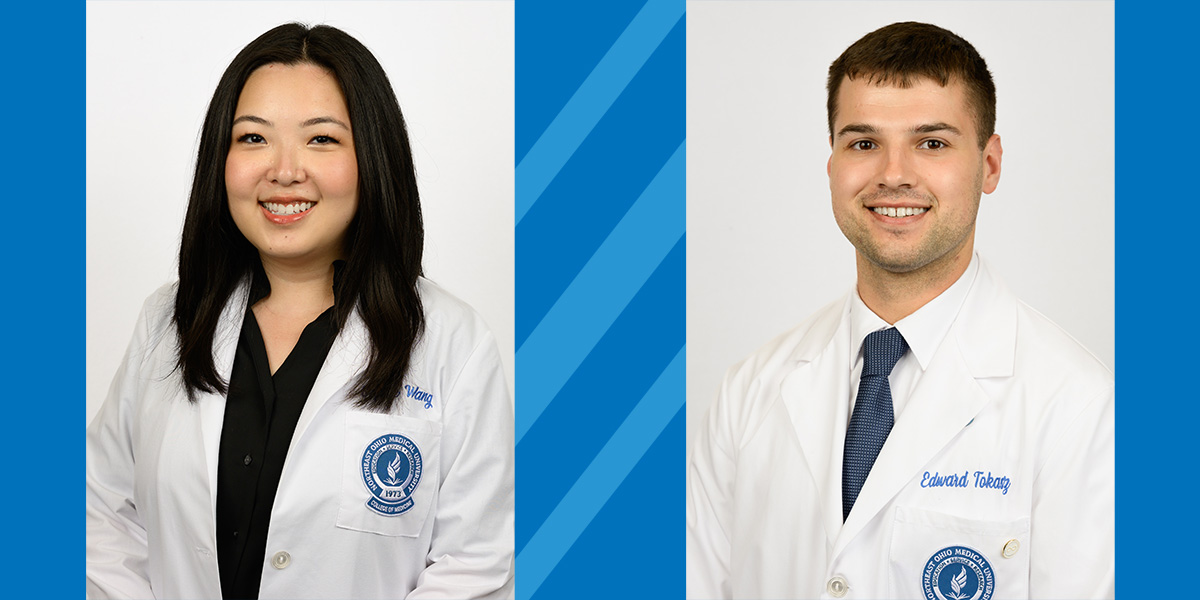
Medical students complete NEOMED summer research fellowship focused on community reentry
This summer, second-year medical students Sophie Wang and Edward Tokasz completed a research fellowship focused on community-engaged research and the experiences of individuals returning to their communities after incarceration. Throughout the fellowship, which was led by Stacey Barrenger, Ph.D., associate professor of psychiatry, they worked with community members and local stakeholders in Portage County to better understand the resources available to and utilized by people navigating reentry.
The students were joined by Amanda Nill, a Ph.D. student at Kent State University, as well as Bridget Stuntz, a peer recovery specialist at OhioMeansJobs. Their work centered on a community needs assessment of re-entering citizens in Portage County, Ohio. Over the course of the fellowship, the students engaged with people with lived experience of incarceration through a series of structured focus groups.
While the fellowship provided an opportunity to develop research skills, the most meaningful part of the experience for both students was the opportunity to work directly with members of the Portage County community and learn from their experiences. Throughout the fellowship, Wang and Tokasz spent much of their time outside of the traditional academic research setting, speaking with individuals who had lived experience of incarceration to hear their perspectives and understand the challenges people encounter when navigating life after incarceration. Rather than beginning with a prescriptive solution, the experience encouraged the students to approach the community and allow participants' experiences to shape their understanding of the issues they face.
One of the most valuable lessons was learning the nuances of community-based research and the way it requires a different approach than traditional academic research. Throughout the process, building relationships, earning trust and creating space for people to share their experiences were just as important to the project as collecting data. The experience also challenged them to think critically about what it means to conduct research with a community rather than simply conducting research about a community.
For Wang and Tokasz, the fellowship offered the opportunity to gain a perspective that cannot be gained solely through a classroom, textbook or clinical experience. It reinforced the importance of approaching communities with humility and recognizing that the people most affected by a problem are often best positioned to explain what needs to change.
About the experience, Tokasz reflects, “Working with citizens of Portage County on this research really allowed me to step away from the campus environment and feel more connected to the surrounding community. The work we did could have a direct impact on the community in which we receive our medical education, which I think is important.”
Adding on, Wang remarks, “This experience reminded me that research is not just about collecting data, but about understanding the people behind that data and making sure that the questions we ask and solutions we pursue are grounded in their lived experiences.”
The fellowship culminated in two poster presentations of their findings that will be presented at the NEOMED Research Symposium, as well as through dissemination at the Portage County Reentry Coalition and to other local stakeholders at events such as the Portage/Summit County Community Reentry Experience. As they return to medical school, both students will carry these lessons into their future work as physicians and researchers. The fellowship gave them a greater appreciation for community-engaged research as a way to bridge medicine and the lived experiences of the people physicians serve and demonstrated that meaningful research begins with listening.
- submitted by Sophie Wang