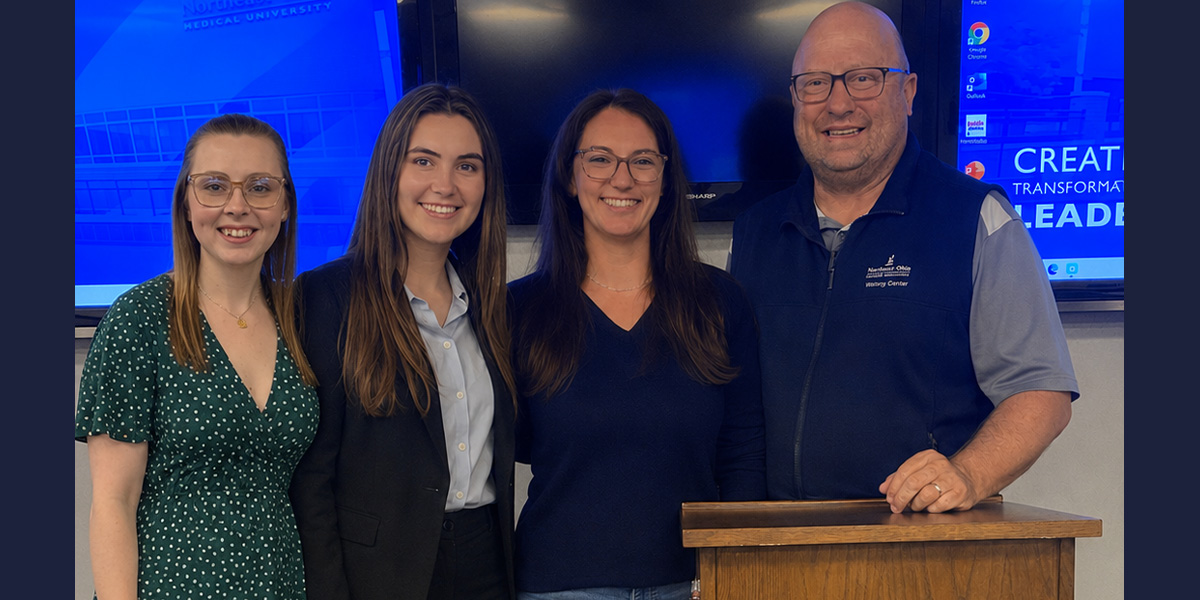
Medical students complete NEOMED Writing Center summer fellowships
In the summer of 2026, the NEOMED Writing Center introduced its inaugural fellowships: The Writing Center Research Fellowship and the Writing Center Humanism Fellowship, thanks to generous support from Rebecca German, Ph.D., and the Office of Research and Sponsored Programs.
Amanda Wang, a second-year medical student at NEOMED, completed the inaugural Writing Center Research Fellowship. Julia Johnson, a third-year medical student, completed the Writing Center Humanism Fellowship.
Over eight weeks, Wang and Johnson worked approximately 160 hours alongside Writing Center faculty mentors, Brian Harrell and Brook Wyers, gaining hands-on experience in scholarly and humanistic writing, the publication process and academic research.
Writing Center Research Fellowship
During the research fellowship, Wang contributed to six manuscripts submitted to peer-reviewed journals, serving as first author on five and co-author on one. The article, Beyond Combining Therapies: A Reflection on Conceptual Pluralism in Integrative Medicine, for which she is first author, is in press in Explore (journal pre-proof is online ahead of publication).
Her other scholarly work includes:
- Beyond Integration: Redesigning Clinical Infrastructure for Whole-Person Care — most recently submitted to European Journal of Integrative Medicine (first author)
- Bridging the Divide: Finding Common Ground Between Eastern and Western Medicine — submitted to Family Medicine (first author)
- Heard — submitted to Pulse (first author)
- Letter to the Editor: A Response to Hecht et al.’s “Improvement in Medical Education” — submitted to Family Medicine (first author)
- The Medical School Writing Center: Toward a Discipline-Specific Theory — submitted to Academic Medicine (co-author)
In addition to her publication efforts, Wang shared her fellowship experience with NEOMED faculty, staff and students during a campus presentation, discussing the research process, the value of writing mentorship and the impact of the fellowship on her development as a scholar.
Missed her presentation? Watch the recording here.
Writing Center Humanism Fellowship
As part of the humanism fellowship, Johnson focused her attention on two big projects:
A short story titled “Does Atlas Carry the Moon Too?,” a story that centers around the character, Jen. A doctor finds herself working on Luna due to the demand for medical professionals in space. Johnson explores a future world where space advancement has surpassed what we know in our current present, with humans living on Mars, Luna and the Asteroid Belt. Through this story, Johnson explores what it would be like for doctors to practice in space, the ethical dilemmas that come along with it, the advancement of certain technologies and the mysteries that come along with them.
Johnson’s main project was an ethics research project focused on transhumanism and technology such as neural links. She explores the beginning of transhumanism and the issues that arise with said technology, such as privacy and legal and medical ethics. The impact that these technologies will have on individuals and the future of medicine is unknown. Johnson plans to submit an ethics lecture through the Northeast Ohio Area Health Education Center (AHEC).
These projects will soon be submitted to literary magazines and peer-reviewed research journals. A publication announcement for both will be made when accepted for publication.
Wang and Johnson will present posters at the NEOMED Research Symposium this fall detailing their writing and research accomplishments and highlighting the Writing Center fellowship model.