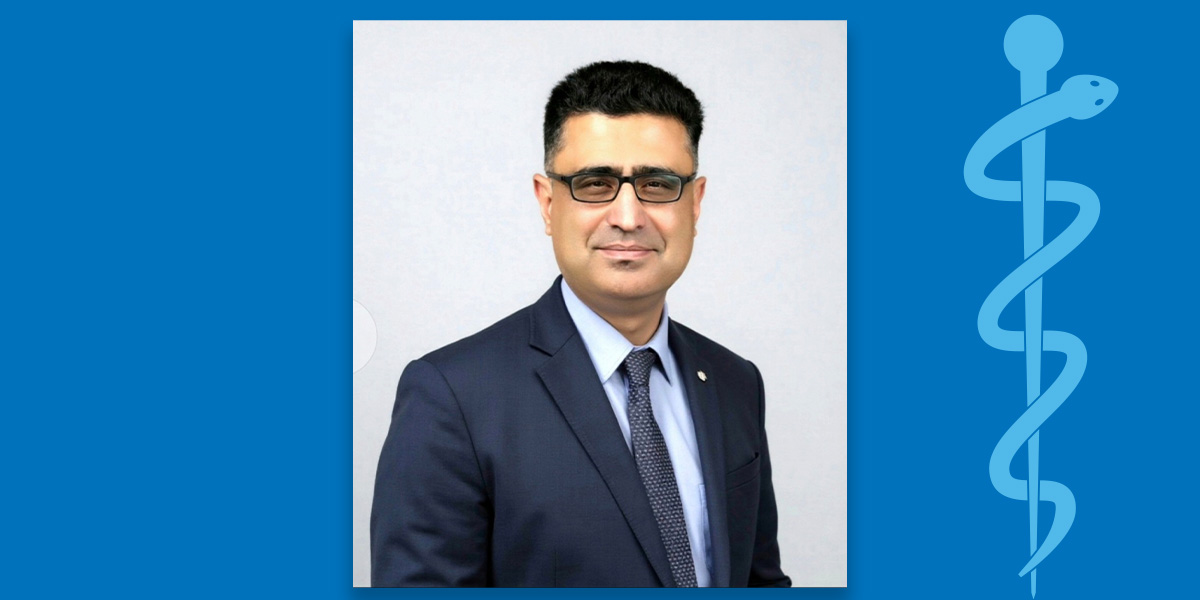
Meet the chair: Psychiatry
Mansoor Malik, M.D., M.S., M.B.A., DFAPA, FACP, joined the NEOMED College of Medicine in July as the Margaret Clark Morgan Endowed Professor and Chair of the Department of Psychiatry. He shared his thoughts on his new role and plans for the department with The Pulse.
What is your role at NEOMED?
I serve as the Margaret Clark Morgan Endowed Professor and Chair of the Department of Psychiatry. My role includes providing academic and strategic leadership for the department; supporting our faculty, staff and students; strengthening psychiatric education across the medical curriculum; expanding research and scholarship; and developing partnerships with health systems, community mental health organizations and other institutions throughout Northeast Ohio and across the state.
An especially important part of the role is building on the department’s longstanding history in community psychiatry. NEOMED Psychiatry has developed a distinctive model in which an academic department does not simply educate students and conduct research, but also works directly with community agencies, health systems, state organizations, philanthropic partners such as Peg’s Foundation, and others to improve how mental health care is delivered.
Where were you before?
Before joining NEOMED, I was a professor of psychiatry at Johns Hopkins University School of Medicine and served in leadership roles within the Department of Psychiatry and Behavioral Sciences at Johns Hopkins Bayview Medical Center. Earlier in my career, I spent more than a decade at Howard University College of Medicine, where I served as professor of psychiatry and residency program director.
Where did you train?
I received my medical degree from Punjab University, Pakistan, and subsequently completed postgraduate psychiatric training in Dublin before coming to the United States. I completed my psychiatry residency at MCP-Hahnemann University in Philadelphia and later completed a fellowship in geriatric psychiatry at Dartmouth-Hitchcock Medical Center.
What made you choose to come to NEOMED?
NEOMED has a distinctive mission and an extraordinary opportunity to make a difference across Northeast Ohio and the state. I was particularly attracted by its strong community orientation, its partnerships with health systems and behavioral health organizations, and its commitment to populations and communities that have historically had limited access to care.
I was also impressed by the history of the Department of Psychiatry itself. That legacy was shaped by previous chairs, particularly Dr. Mark Munetz and Dr. Randon Welton, who helped establish and expand the department’s role in community psychiatry, serious mental illness, criminal justice and mental health, education, and statewide systems improvement. Longstanding relationships with partners such as Peg’s Foundation have helped support innovation and extend the reach of this work across Ohio.
I was equally encouraged by the commitment of NEOMED’s leadership, including President John Langell, Provost Forrest Faison and College of Medicine Dean Marc Basson, to expanding the University’s impact in education, research, innovation and community health. Their vision for NEOMED aligns closely with what I believe academic psychiatry can accomplish in partnership with communities across Ohio.
Do you have any plans you can share about the psychiatry program? What would you like to see in the future?
My goal is to build on the strong foundation already established at NEOMED. I would like to further strengthen the psychiatry curriculum and clinical clerkship experience, expand opportunities for students to participate in psychiatry-related research and scholarship, and develop additional clinical and academic partnerships throughout the region.
A major strength of the department is its three Coordinating Centers of Excellence: the Best Practices in Schizophrenia Treatment Center (BeST Center), the Criminal Justice Coordinating Center of Excellence and the Ohio Program for Campus Safety & Mental Health. Through these centers, the department has developed an unusually strong statewide role in translating evidence into practice — improving treatment for people with serious mental illness, strengthening responses at the intersection of mental health and the criminal justice system, and advancing suicide prevention and mental health on college campuses.
I would like to build on this infrastructure and connect the centers even more closely with education, research and scholarship. We can also expand the use of Project ECHO and other learning-collaborative models to bring specialized expertise to clinicians and communities that may not otherwise have ready access to it. These approaches allow an academic department to disseminate knowledge and evidence-based practices far beyond its own clinical sites and create learning networks across the state.
I also hope to expand our work in early intervention for psychosis, community and public psychiatry, suicide prevention, behavioral health workforce development, crisis response, and the interface between mental health and the criminal justice system.
Over time, I would like to see NEOMED become a nationally recognized leader in community mental health innovation. That includes not only developing better clinical programs, but also contributing to national conversations about how mental health care is financed and organized. Sustainable improvement will require new approaches to Medicaid and other payment systems, greater integration of mental and physical health care, better financing of services for people with serious mental illness, and reimbursement models that support prevention, recovery and community-based care rather than fragmented episodes of treatment.
NEOMED's combination of community partnerships, statewide Coordinating Centers of Excellence, educational innovation and applied research gives us an opportunity to test approaches in Ohio, rigorously evaluate their impact, and contribute solutions that may have relevance nationally.
What is the most important issue right now in the field of psychiatry? How is NEOMED preparing students to address that issue?
One of the most important challenges in psychiatry is not simply developing effective treatments, but ensuring that people can actually access them. We continue to face major shortages in the behavioral health workforce, fragmentation between mental health and general medical care, and significant disparities in access, particularly in rural and underserved communities.
Preparing students to address this requires more than teaching diagnosis and treatment. They need experience working in interdisciplinary teams, understanding community systems of care, recognizing social and structural factors that affect mental health, and learning how to translate evidence into real-world practice.
This is where NEOMED has a particular advantage. Through its community-based educational model, Coordinating Centers of Excellence and innovative approaches such as ECHO learning networks, students can see that psychiatry extends well beyond the walls of a hospital. Mental health care intersects with primary care, schools and universities, law enforcement and courts, housing, families, financing systems and community organizations. Preparing the next generation of physicians to understand and improve those systems will be increasingly important.
What led you to pursue a career in psychiatry?
I was drawn to psychiatry because it sits at the intersection of medicine, neuroscience, psychology and the social sciences. Few areas of medicine allow physicians to understand patients so comprehensively — not only their biology and symptoms, but also their experiences, relationships, communities and circumstances. Psychiatry also offers the opportunity to develop long-term therapeutic relationships and to help people recover at some of the most difficult points in their lives.
Anything else you’d like to add?
One of the things I have enjoyed most since arriving at NEOMED has been meeting the faculty, staff, students and community partners who are deeply committed to improving mental health care. I feel fortunate to follow leaders such as Mark Munetz and Randon Welton and to inherit a department with a strong tradition of community psychiatry and statewide engagement.
I am particularly excited by NEOMED’s willingness to develop innovative solutions to some of the most difficult challenges facing healthcare. A good example is the Certified Mental Health Assistant (CMHA) program, which represents a new approach to addressing critical behavioral health workforce shortages. As demand for mental health services continues to grow, universities need to think creatively about how we educate and deploy the workforce rather than relying exclusively on traditional professional pipelines.
With the support of President Langell, Provost Faison, Dean Basson, our philanthropic partners such as Peg's Foundation, our faculty, staff and community partners, I believe NEOMED has an opportunity not only to educate the next generation of health professionals, but also to help shape the future of behavioral health care in Ohio and nationally. That combination of education, innovation, scholarship, policy and community impact is one of the things that makes NEOMED particularly exciting to me.