Reflecting on 50 years of NEOMED ahead of time capsule opening
By Joseph Zarconi, M.D. ('81)
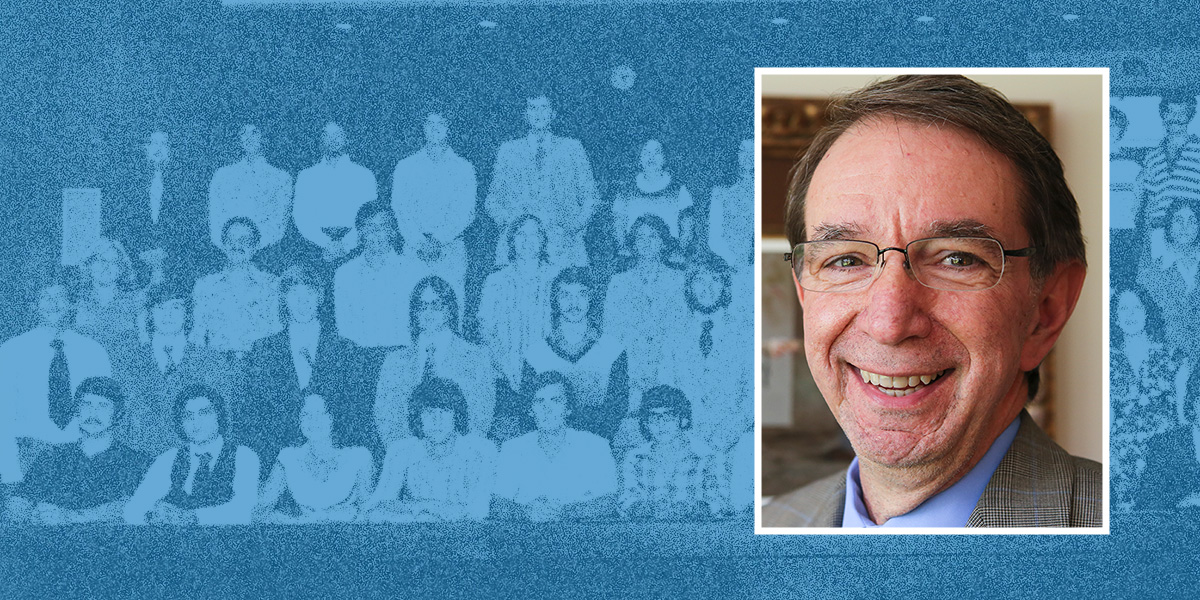
Dr. Zarconi was a member of NEOMED’s first class of students, and remained part of the NEOMED community as an alumnus and faculty member, while holding assorted leadership roles throughout the years. He reflects on his 50 years as part of the NEOMED community, as he prepares to speak at the Time Capsule Opening event on Monday, Aug. 24, from noon-1 p.m.
As a first-year pre-veterinary medicine student at Youngstown State University, I heard about a new medical school that was going to be starting up in Ohio, so I decided to apply. I could never have known how that decision would chart the course of my life and career.
My admissions interview was conducted by two individuals, a retired and quite elderly psychiatrist, and the dean of YSU’s college of arts and sciences. Early in the interview I was asked if I played any musical instruments. I did not. But I didn’t stop my answer there. I went on to say that if I ever would, I’d try the piano. That was a mistake. For the next thirty minutes the psychiatrist asked questions about classical pianists and composers, about someone with a 13-piano key finger spread, about famous symphonies. All of my answers over those 30 minutes were some form of “No, I don’t know, I’ve never heard of him, I’m not familiar with that,” and on it went.
As the interview wound down, I concluded two things. First, I would certainly be flatly rejected. Second, I no longer had any desire to attend a medical school that expected me to know so much about classical pianists. To end the interview, YSU’s college dean asked if there was anything else that I wanted them to know about me. Having already conceded any chance of admission, I calmly and as tactfully as possible expressed my surprise at the tenor and content of the interview and shared that I couldn’t understand how their questioning helped them learn anything about my potential for success as a medical student. I assured them that if they were looking for a classical music scholar they should remove me from their applicant pool, but that if they were truly interested in whether I might make a capable medical student, perhaps they could schedule a follow-up interview and ask me questions about that.
I walked across campus to tell my girlfriend that I was still interested in veterinary medicine. Sometime later I got an acceptance letter, which was baffling to me. A week or two later I bumped into the arts and sciences dean who had interviewed me, and he enthusiastically said hello and congratulated me on my admission. Sheepishly, I confessed to being quite confused about their decision given how I felt the interview went. He then explained that it was my clear and direct feedback to them about my interview experience, and my willingness to stand up and defend myself as a candidate that sold them on my candidacy. When I eventually recovered from the interview, I was actually quite excited to be admitted to the school’s very first class.
Another First Impression
I believe my first visit to the Rootstown campus was when the newly admitted charter class was invited to attend the groundbreaking ceremony for the institution. I vividly recall stepping onto that property, gazing north and seeing farmland, gazing south and seeing farmland, gazing east and then west, and seeing farmland. A variety of dignitaries from the partner hospitals, health systems and universities, and a number of government officials, had been assembled to acknowledge the start of our new medical school. There were members of the press. It seemed like a really big deal.
I also recall Mr. and Mrs. Brian Jones, who had owned that property, seated on the stage as dignitaries. I had a chance to meet them and have a conversation and came to see them as extremely humble and kind people who were very excited to have participated in the founding of this institution. But mostly, watching the dignitaries digging their shiny shovels into the dirt of that farm, and hearing the speakers at that event describing how we would ultimately be receiving our medical degrees there in a few short years, it struck me as such an incredible leap of faith. I must say that I wondered whether it would really happen, but it seemed like such an incredible opportunity to be pioneers in that first class and to have the opportunity to witness the institution’s birth and development.
As a first-generation college student, having grown up in a lower middle-class blue-collar family, I had no doctors in my family and had had no contact with physicians other than an occasional visit to our family doctor. I had no idea what physicians were all about. I remember getting to meet Dr. Stanley Olsen and Dr. Robert Liebelt and learning a bit about who they were and what they were trying to accomplish. They seemed like such giants to me. It made me glad just to be a part of all of it.
I think my next visit to the campus was for the cornerstone laying ceremony in 1976. I was one of the students that was selected to speak at that event, and I again recall being struck with the historical significance of the box they were placing behind the cornerstone, and the prospects of its being reopened at some point so far off into the future. I don’t know what I said at the podium that day, but I suspect somewhere in my message was an offer of gratitude on the part of myself and my classmates for being given the opportunity to be part of this pioneering journey.
At Youngstown State, those of us who were admitted into the first class were in many ways treated as a special group of students. We had a number of meetings with representatives of the emerging NEOUCOM basic science faculty, as well as with Dr. Liebelt, and the YSU administrative folks engaged with us a fair bit back then as well. It felt like something really special was happening amongst the three universities in the building of a different kind of medical school, and I’m not sure I fully appreciated what all of that meant as I was working hard to complete my baccalaureate degree.
A Year of Transition
I don’t think I have any particular special memory of the year 1976, other than to say that I really had no idea what I was getting into as I was preparing to transition from being a college student to being a medical student. I was excited about becoming a physician, but I really had no idea what it was going to take or what the experience of medical education was going to be like. The only thing that gave me comfort was listening to people like Dr. Liebelt, Dr. Olsen and some of the new faculty who were being hired to teach us at Rootstown. They all seemed very professional, highly qualified, and genuinely kind to us as members of their first class. And they all seemed to actually believe that this thing was really going to happen.
Being in the first class of a brand-new medical school turned out to be a very unique experience, at times exhilarating but not without its frustrations. When we started the medical school curriculum in 1977, our new medical school was a single building with a single auditorium (now known as the Olsen Auditorium) classrooms and lab spaces, and a mysterious cadaver lab.
Each of us was assigned a study carrel. I remember a lot of lonely hours spent sitting and studying in those little carrels, and I recall that a few of my charter classmates actually spent occasional night in those little rooms from time to time. The curriculum evolved into a six-day-per-week program, so we were in classrooms, the lecture hall or lab sessions from 8 a.m. to 5 p.m. Monday through Friday and on Saturday until about 1 in the afternoon as I recall. It was certainly the most rigorous curriculum I had ever experienced, and there were many times when I wondered whether I would be able to complete it. I will say, however, that often when I felt I was struggling, I had a sense that the faculty we were working with were heavily invested in in our success. I also always felt that Dr. Lebielt was heavily invested in our success as well. And I recall that in those first two years we had no cafeteria in that building and no food services. There were a few vending machines, and I definitely ate a lot of Hostess Ho Hos during that time.
As the first class of medical students, we had the opportunity to develop fairly close and warm relationships with the charter faculty. I also recall that Dr. Liebelt made a lot of effort to get to know us, and to allow us to get to know him a bit as well. Dr. Liebelt wasn’t just our dean. He was actively involved as a teacher. He taught us embryology, and his trademark multicolored chalk drawings in the lecture hall became a part of his legend.
We were also very fond of Dr. Ted Voneida, who taught neuroanatomy and neurobiology. He was a very humble man with a wonderful sense of humor, and he made a lot of effort to get to know us individually. I’m sure most of us in the class recall his famous poem, or maybe it was a song, entitled “Oh, We Ain’t Got no Weenie in the Brain.” He made one of our most difficult subjects more fun.
Drs. Glenn Saltzman and Mark Savickas taught behavioral sciences and were also very popular among our class. They, too, were excellent teachers also invested in getting to know us personally. Our class undoubtedly also has very fond memories of Dr. Norm Taslitz, the man who introduced us to our very first “patient” in the cadaver lab. I recall that he made that introduction with such grace and with such respect for the deceased people who donated their bodies for our studies. He led the very rigorous anatomy course.
And a particularly beloved professor was Dr. Norman Paradise, who taught us the extremely complex and difficult physiology course, but made it a course that we could all handle. He was relentless in making sure we were able to master physiology, and he made everything he taught relevant to what we would eventually see in clinical medicine. And perhaps our most challenging course in the preclinical years was what we called biochemistry, what they called molecular pathobiology. They even had to make the name of the course difficult! The course was led by Dr. Ferenc Hutterer, a man who was perhaps our most intimidating, even tyrannical professor. To soften his edges, they recruited Dr. Alan Steggles and Dr. Phil Westerman. These two were easy to love, but Dr. Huterer was an acquired taste. I think it took us the better part of a year to discover that inside his hard shell and stern approach was a kind man who actually really cared about our success. Unfortunately, he held an incontrovertible belief that our success depended upon our passing his most important course.
And while they were not faculty, there were two women who were critical to NEOUCOM’s early success, and who were beloved by the charter class. Margaret Dietz and Mary Jane Kelly were our mothers away from home during the very difficult first couple years of medical school. They often served as our moral support, and as connectors to the faculty and administration of the institution. I don’t think our fledgling medical school could’ve had as much success as it did in those early years without those two very capable and dedicated women working in the offices of the dean and provost serving the institution and all of us.
Now, after an intensely close and personal 50-year relationship with this institution, having had the incredible privilege of being a member of its charter class, and later becoming a long-standing member of its faculty, I can’t describe what a joy it has been to watch these farmlands of Rootstown evolve into a highly respected College of Medicine, and ultimately a highly respected health professions university of now four colleges.
The Bumblebee
I’ve often described the whole NEOUCOM project as the bumblebee which, by all the rules of aerodynamics cannot fly, and yet NEOUCOM did, in fact, take flight. I’m proud to have been one of the young people that was selected to be in its very first class. I’m proud to be a graduate of this institution. I’m proud to have had the privilege of serving for so many years as a member of NEOUCOM’s and NEOMED’s faculty.
In the 50 years that have lapsed since the laying of that cornerstone in 1976, a great deal of history has unfolded in Northeast Ohio as consequence of the work of NEOMED. As a naïve and inexperienced college student bearing witness to the laying of that cornerstone, I could never have imagined what we would be celebrating 50 years hence. For all of it, I am incredibly grateful.
The landscapes of healthcare, and of health professions education, in Northeast Ohio and well beyond, have been transformed by the work that began in those years when this piece of stone was put in place.
Since its placement, 4,962 new physicians and 1,111 new pharmacists have been launched into the healthcare work force. 194 graduate degrees have been granted. 52 young students are now enrolled as our first College of Dentistry class. They are our newest pioneers! And a five-decade portfolio of research and innovation in the basic medical sciences and clinical sciences has blossomed from this place.
The healthcare and academic landscapes of this region have been transformed in countless ways, and that transformation has extended its influence across this country and across the globe. All of that began right here. I’m grateful and honored to have borne witness to those five decades, and to have played some small part in its efforts to transform health care and medical education for all of us. The challenge of building upon these successes going forward now rests on the shoulders of NEOMED’s current leadership, faculty, staff and students. And their commitments must continue to acknowledge that caring for the sick must always be seen as an art as well as a science, requiring a grounding in humanistic values, principles and skills, including a deep understanding of the human condition.
I look forward to the next 50 years of NEOMED!