Student research spotlight: Alexander Keith
Third-year medical student Alexander Keith was one of more than 200 NEOMED students to present their scholarly work at the 2025 Student Research Symposium. Keith shared with The Pulse the inspiration for his work, what he learned and next steps for his research.
by Margaret Bernstein
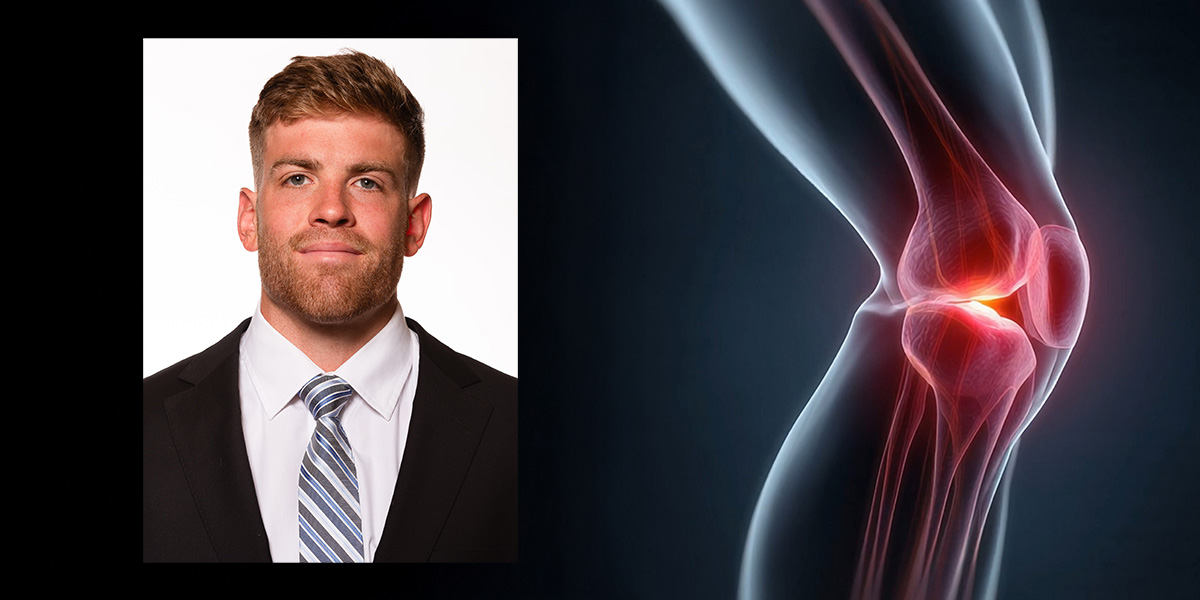
When you switch on your TV to watch pro sports, it's common to see a list of injured players flash on the screen before the game starts. For Alexander Keith, a third-year student in the NEOMED College of Medicine, that list became the jumping-off point for the project he presented during the annual student research symposium, "Return to Play Following Multi-Ligament Knee Injuries in Elite Athletes: Challenges, Outcomes and a High-Profile Case".
Keith examined publicly available data about athletes who suffered multi-ligament knee injuries (MLKIs) while playing pro football, basketball, soccer, ice hockey, rugby, mixed martial arts, alpine skiing or gymnastics. Those specific sports were chosen based on their more brutal nature and the higher rate of knee injuries. "I wanted to better understand outcomes across multiple high-level sports, especially whether athletes can return not only to play, but to their prior level of performance," he explained.
His research found that about 80% of elite athletes with MLKIs are able to return to their sport, typically one year after surgery, but only 70% of those returning were able to play at pre-injury levels. To gather this data, he looked at each athlete's individual statistics -- for instance, an NFL running back's rushing yards or an NBA point guard's points and assists. If the athlete was able to reach at least 80% of his or her pre-injury stats within two full seasons after returning, Keith classified that as a return to prior performance levels.
He also found that it mattered greatly which ligaments were injured. More complex injuries involving both cruciate ligaments tended to lower an athlete's chances of returning to play. "The cruciate ligaments are deep in the knee. They're major stabilizing ligaments, important for athletes competing at a high level," he said.
Keith, who conceived the project idea and designed the study himself, served as lead investigator. Other third-year students who assisted with manuscript preparation and revisions for submission to the Journal of Medical Sciences at NEOMED were Nathan Cuttica, Nicholas Sciarretti and Stephen Hedberg.
Their findings provide useful information that can help orthopaedic sports surgeons and athletic trainers set expectations and be "upfront and honest with patients about what the recovery process is going to look like," Keith said.
Keith, who played football as a student at Washington and Jefferson College in Pennsylvania, said the inspiration for the project stems from his personal interest in sports and also sports medicine. "I understand how strongly athletes identify with their sport and how severe injuries can impact not only physical performance but also mental health."
"If I can play even a small role in helping athletes return to the activities that define them, that would be a very meaningful career for me," said Keith, whose future plans include applying for a residency in orthopaedic surgery and completing a fellowship in sports medicine.