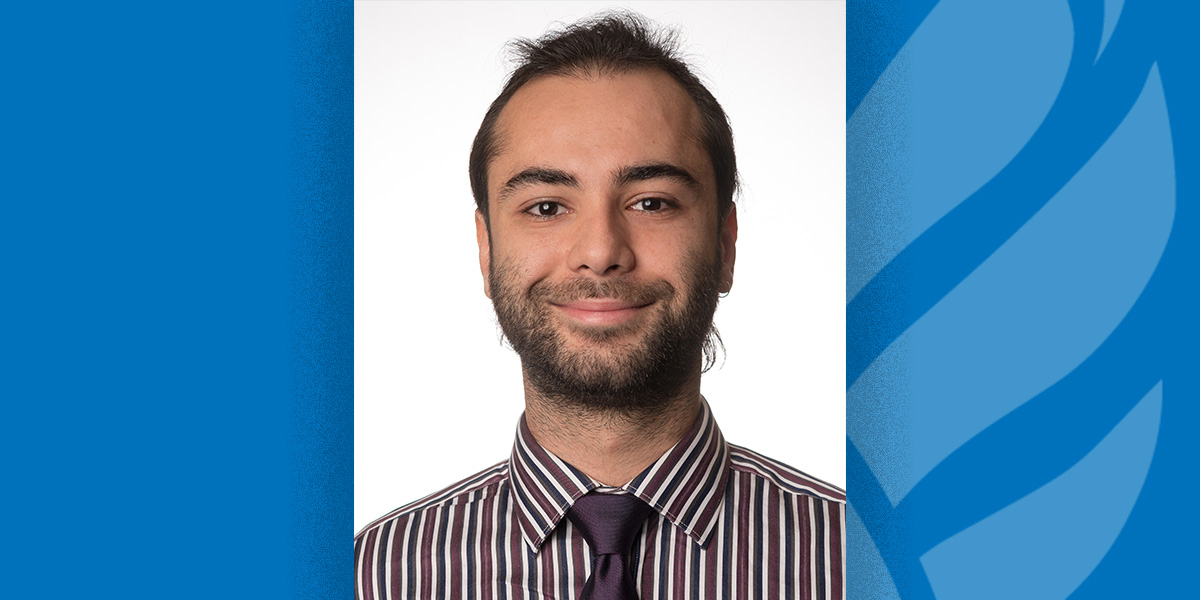
Student research spotlight: Ali Khasaei Nezhad
Rising fourth-year medical student Ali Khazaei Nezhad was one of more than 200 NEOMED students to present their scholarly work at the Student Research Symposium last fall. Nezhad shared with The Pulse the inspiration for his work, what he learned and next steps for his research, titled “Effectiveness of Deep Transcranial Magnetic Stimulation treatment in treatment-resistant unipolar and bipolar depression.”
What was the inspiration for your research?
I was inspired by a fundamental lack of clarity in the literature regarding how real-life patients interact with and receive treatment. It was unclear whether new modes of treatment such as Deep Transcranial Magnetic Stimulation (dTMS) or Repetitive Transcranial Magnetic Stimulation (rTMS) are actually effective for real non-standardized patients, who are far removed from the types of patients usually included in large landmark studies. It can open the way for broader access to such care if the effectiveness of these treatments is proven. I reviewed data of 21 patients who opted to receive a course of rTMS or dTMS treatment from the Department of Psychiatry’s Mood Disorders Program at University Hospitals Cleveland Medical Center between 2020 and 2022. With further analysis, I narrowed my focus down to 16 patients. These patients were from all walks of life, and many had tried various medications for their psychiatric care earlier with little success.
What are your main findings?
My main findings included a moderate but very real and statistically significant improvement in depression symptoms for patients receiving dTMS and similar treatments. My research points the way to greater future advocacy for such patients to receive these kinds of treatments, even if medical centers have been hesitant about investing/expanding these resources, and Insurance has been hesitant about funding these treatments. Of note, this was a small study and requires larger follow-up to prove the effectiveness of dTMS in these patients in order to convince health systems that it is worth funding. More research would also clarify what factors predispose patients to benefit from such treatments, and which patients are likely to benefit less.
How will this project improve health?
This sort of research has the potential to improve the health of many suffering from Treatment-Resistant Depression (TRD) by opening avenues for them to receive novel modes of treatment such as dTMS. It could also improve care by showing that TMS does not work in some patients, and the healthcare system/research world is better off not wasting its time and investing in other less-studied avenues/treatments in order to improve these patient's lives. My findings indicate that more research is needed to understand why some patients benefit greatly from medication while others benefit more from treatments such as TMS. Additionally, some subpopulations also benefit to varying degrees with the same treatment, such as rTMS alone. There is much ground to be covered in terms of future discovery of better treatments.
Is this an area you plan to work in, in the future?
Yes. Psychiatry is the field I love and aspire to go into. Advocating for novel treatments for my patients is a special interest of mine, and I aim to continue doing this throughout my career, regardless of the actual treatment modality.