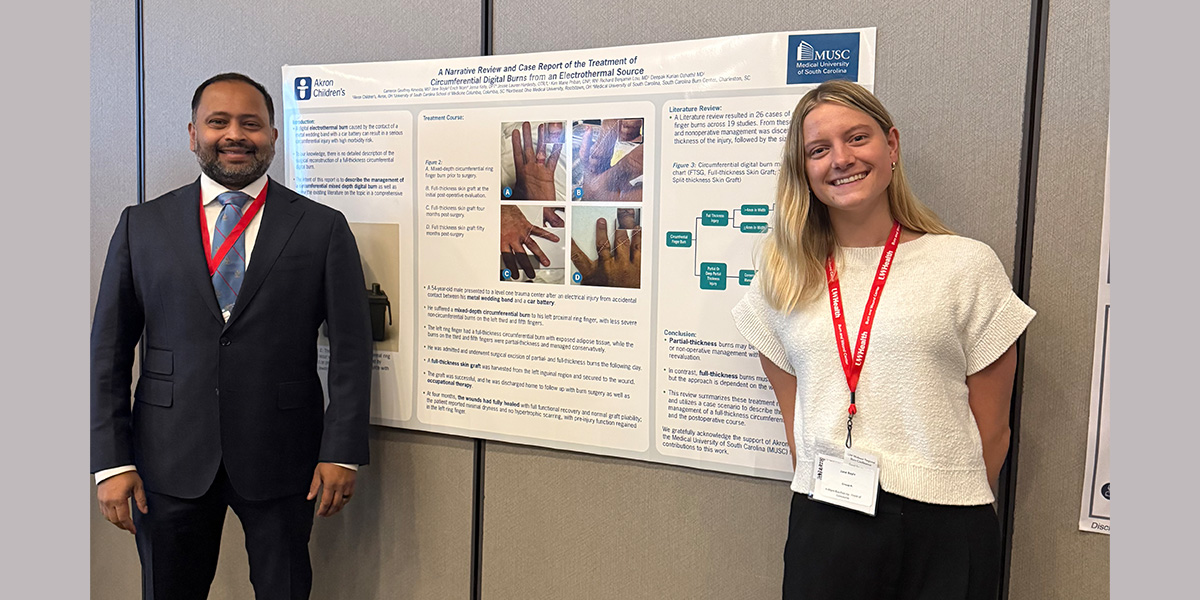
Student research spotlight: Jane Boyle
Third-year medical student Jane Boyle was one of more than 200 NEOMED students to present their scholarly work at the Student Research Symposium last fall. Boyle shared with The Pulse the inspiration for her work, what she learned and next steps for the research, titled “A Multi-Center Trial Exploring Frailty as a Predictor of In-Hospital and Long-Term Mortality Among Older Adult Burn Survivors.”
You were working with older adult burn survivors. What was your inspiration and how did you end up working on this project?
I worked with Dr. Deepak Ozhathil, a burn surgeon at Akron Children’s Hospital. He had this project that he was super excited about, working with the elderly burn population in a multicenter trial. He's working with doctors across the United States and Canada to produce and analyze this dataset.
The current metric to measure mortality in burn patients is called the “Baux score.” It's calculated by examining the percent total surface area burned and the age for burn patients. The modified Baux score takes the previous two metrics into account in addition to the presence of absence of an inhalation injury.
With this research as well as his and his colleague’s experience in the operating room, Dr. Ozhathil believed in the importance of including frailty as a measurement of mortality. He and his colleagues saw that oftentimes more frail patients didn’t do as well postoperatively and he wanted to prove that.
We used this huge dataset that multiple member institutions contributed to with more than 1,600 entries. We found that using frailty in addition to Baux scores did make a difference in being able to predict mortality. That's really important because this helps the doctor have better points-of-care conversations with elderly patients. Is a patient going to go home or is patient not going to go home? Are they going to live? A lot of times patients and patients’ families just want answers, and including frailty as a predictor of mortality will allow doctors to make more informed decisions.
How are you measuring frailty?
We utilized the Canadian study of health and aging clinical frailty score (CSHA-CFS). The frailty measurement is a scale from 1 to 7. One is very fit. That’s people who are robust, active, energetic and motivated. These people exercise regularly. And then seven is completely dependent for cognitive and physical care.
You mentioned that Dr. Ozhathil is working with physicians from across the country. How many clinics are involved in this research?
There are 12 burn centers in the U.S. and Canada. And then there were 1,632 total entries into the data. We analyzed the data for in-hospital and in the long-term, post-discharge.
Are there any other key findings that you uncovered?
We thought that including frailty would be incredibly important for talking about predictions of care for elderly patients. We showed that for in-hospital outcomes, the combination of frailty and Baux score improved current mortality prediction models by 16%. In the long-term, frailty alone outperformed all traditional burn mortality metrics. We also found that our data matched the literature, which says a frailty cutoff of four is the best indicator of mortality.
What is the potential impact of this research, especially in terms of human health? If it’s predicting mortality, what do you do with that information?
When I started working on this, my grandfather had recently passed away. Seeing those points of care and talking to people in the hospital, this kind of showed me how important it is to have very valuable predictive metrics. These metrics allow physicians to have improved points-of-care conversations with patients with different levels of burns.
I think information for the patient and for the family is so valuable. As a doctor, you learn so much, which makes it so much worse to have to look someone in the face and say, ‘I don't know.’ Right? So improving the metrics, improving predictability, will help us have better conversations with families.
Do you plan to continue participating in this research or similar research?
Yes, I work with Dr. Ozhathil still. We're still working on publishing, so I'm excited to do that.
I'm also on a new project now. We’ve started doing the chart review for micronutrients. We’re assessing the value of giving burn victims micronutrients like selenium, copper and zinc and assessing if the outcomes are better or worse when they're given or if they have any impact.
Is this an area you see yourself working in long term? What are your career goals?
I would love to. I chose burns because it sounded interesting. Dr. Ozhathil is a fantastic mentor as well and has helped me so much in the research world and professionally. But I actually found that I really do enjoy working in the burn world because it can be applicable to all of the things that I can see myself doing, like surgery, emergency medicine or dermatology. So I felt like it is really broad reaching and gives me the most opportunities in so many different fields of medicine.