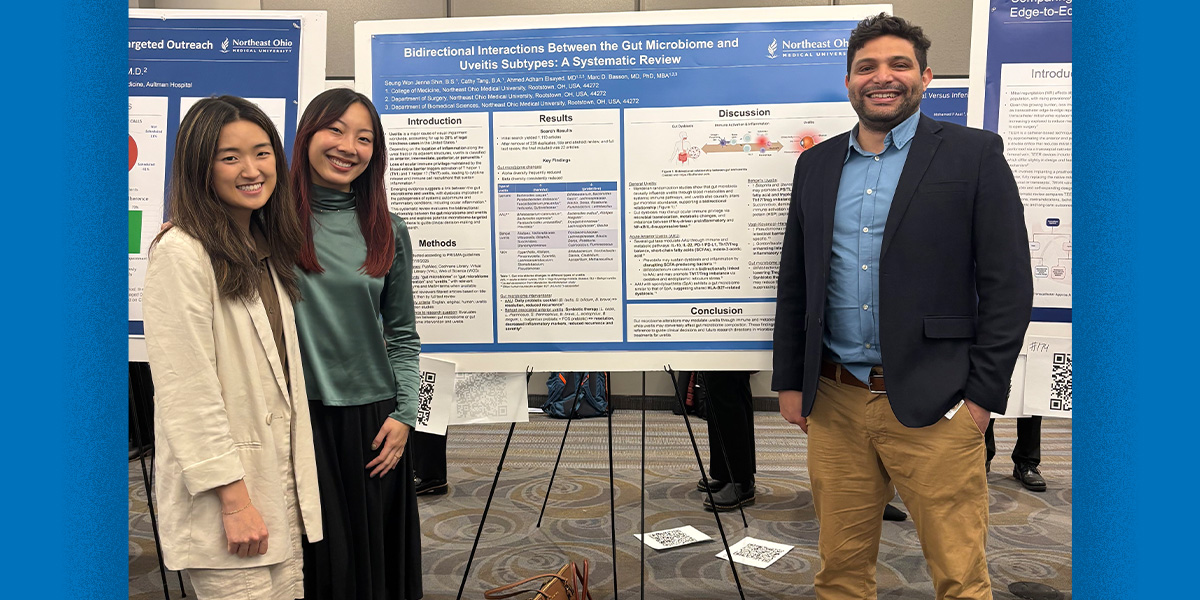
Student research spotlight: Jenna Shin
Rising third-year medical students Seung Won Jenna Shin (pictured above, left) and Cathy Tang were among the more than 200 NEOMED students to present their scholarly work at the 2025 Student Research Symposium. Shin shared with The Pulse the inspiration for their work, what she learned and next steps for the research, titled “Bidirectional Interactions Between the Gut Microbiome and Uveitis Subtypes: A Systematic Review."
What was the inspiration for this project? What led you to the topic?
This project grew out of discussions with my co-first author, Cathy Tang, and my mentor, Dr. Ahmed Adham Elsayed, who had helped many students in the past with systematic reviews, including some related to the gut microbiome. Since my interests currently align with ophthalmology, we decided to explore how the gut microbiome interacts with uveitis, a condition involving eye inflammation that can lead to blindness, particularly in low- and middle-income countries.
Briefly describe the work. What were the key findings you shared?
We conducted a systematic review following PRISMA guidelines, examining human studies on the relationship between the gut microbiome and uveitis. The review involved screening over a thousand articles and eventually filtering down to a little over 20 articles to synthesize findings across multiple uveitis subtypes. Some interesting patterns emerged, such as distinct gut microbial changes across uveitis subtypes with some overlapping or convergent pathways, as well as evidence suggesting the relationship between the gut and eye inflammation may work in both directions. We also found some therapeutic potential for gut-targeted interventions like probiotics. We are planning to submit a manuscript soon for publication and look forward to sharing the full findings in greater detail soon!
What is the potential impact of the research, especially in terms of human health?
Uveitis can seriously affect vision and quality of life, and current treatments often rely on long-term steroids and immunosuppressive medications, which can come with significant side effects. Our review explores whether the relationship between the gut and ocular inflammation could work in both directions, and we hope that this review will call attention to this gap in research that could create new avenues for those who have uveitis and potentially offer options that are easier to tolerate for patients who can't use conventional treatments long-term.
Do you have plans to continue participating in research? What are your career goals?
Yes, Cathy and I are finishing up our full manuscript and submitting it for publication soon. We hope to present our updated findings at another conference, and there are multiple research projects I'm hoping to return to in the summer. My long-term career goal is to make a great first impression of medicine for patients who may be reaching for healthcare for the first time, either through ophthalmology or primary care, so that they can trust and continue their care, while building quality long-term relationships with patients whom I can proudly say I cared for decades later at the end of my career.