Student Research Spotlight: Madeline Guy
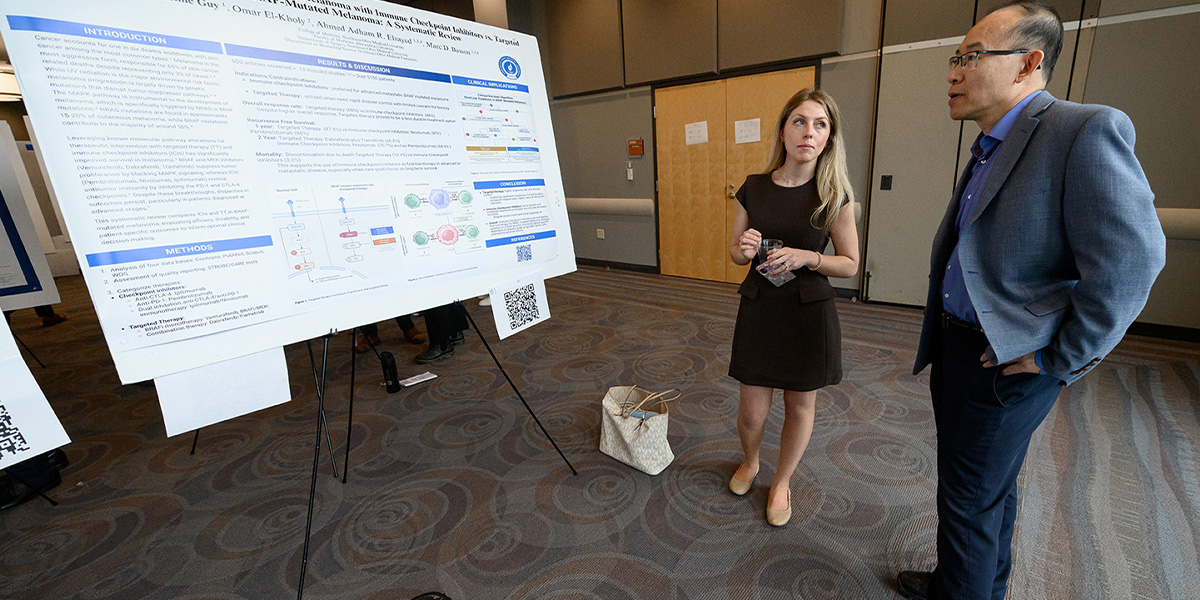
Third-year medical student Madeline Guy was one of more than 200 NEOMED students to present their scholarly work at the 2025 Student Research Symposium. Her poster, titled “Comparison of Therapeutic Outcomes of Immune Checkpoint Inhibitors vs Targeted Therapy in BRAF-Mutated Melanoma: A Systematic Review,” was selected as the First-place Poster Presentation (Clinical and Public Health Category) at the symposium. Guy shared with The Pulse the inspiration for her work, what she learned and next steps for her medical journey.
Please briefly explain your project.
Melanoma is the deadliest form of skin cancer, which originates from the same cells that create skin pigmentation, or melanin. Some people have a genetic variation within these cells known as a BRAF mutation. A BRAF mutation can be thought of as a traffic light that is stuck on green. Typically, the body uses signals, like traffic lights, to regulate growth, telling cells when to grow, slow down or stop division. A BRAF mutation disrupts this system by acting as a continuous green light, leading to unregulated cell growth and eventually cancer.
Not all forms of melanoma have this BRAF mutation but identifying it allows doctors to choose the most effective treatment. The two therapeutic interventions we explored were targeted therapy and immune checkpoint inhibitors.
Targeted therapy blocks the abnormal growth signal caused by the BRAF mutation. In simple terms, it fixes the broken green light that is driving the cancer’s growth.
Immune checkpoint inhibitors work in a different way. Instead of targeting the cancer cell itself, they help the body’s immune system recognize and attack cancer cells. In this sense, it is like replacing the bulbs in the broken traffic light rather than reprograming the traffic system.
Specifically, BRAF mutated melanoma is associated with faster tumor growth and poorer patient outcomes. Now, with the development of targeted therapy and immune checkpoint inhibitors, there is promising evidence of improved outcomes and overall survival.
What was your inspiration to study this topic?
In college, I had an amazing mentor, Dr. David Johnson, who sparked my interest in cellular and molecular biology. Through my time in his classes and research lab, I developed a passion for cellular biology and its physiological effects on the body. Skin cancer research became a natural intersection of my passion for microbiology and dermatology. In our research, we examined how an understanding of cell signaling pathways can inform treatment strategies and improve patient outcomes in BRAF-mutated melanoma.
What are the main findings from your review?
Our research showed while patients have a higher response rate to targeted therapy, immune checkpoint inhibitors significantly improve overall survival and represent a more durable therapeutic option for BRAF mutated melanoma. Checkpoint inhibitors are associated with 47%, 53% and 48% reduction in 1-year, 2-year and overall mortality risk compared to TT.
Targeted therapy may demonstrate quicker response rate although they are associated with increased toxicity and poorer outcomes in the long run. Therapeutic selection should remain individualized, with targeted therapy being a potential first line agent for immunocompromised patients, those with poor prognostic factors or anyone requiring rapid response. To address these differences in therapeutic approach, we developed and incorporated a clinical decision-making algorithm within the manuscript.
What’s next? Is this an area of research you plan to explore further?
I will be applying to dermatology residency this fall and am hopeful for the opportunity to continue exploring my interests through clinical training and research. I am specifically interested in utilizing skin manifestations to aid in earlier diagnosis and intervention of underlying systemic disease. I am excited to continue exploring the field of dermatology and am appreciative of all the mentors who have guided me thus far.