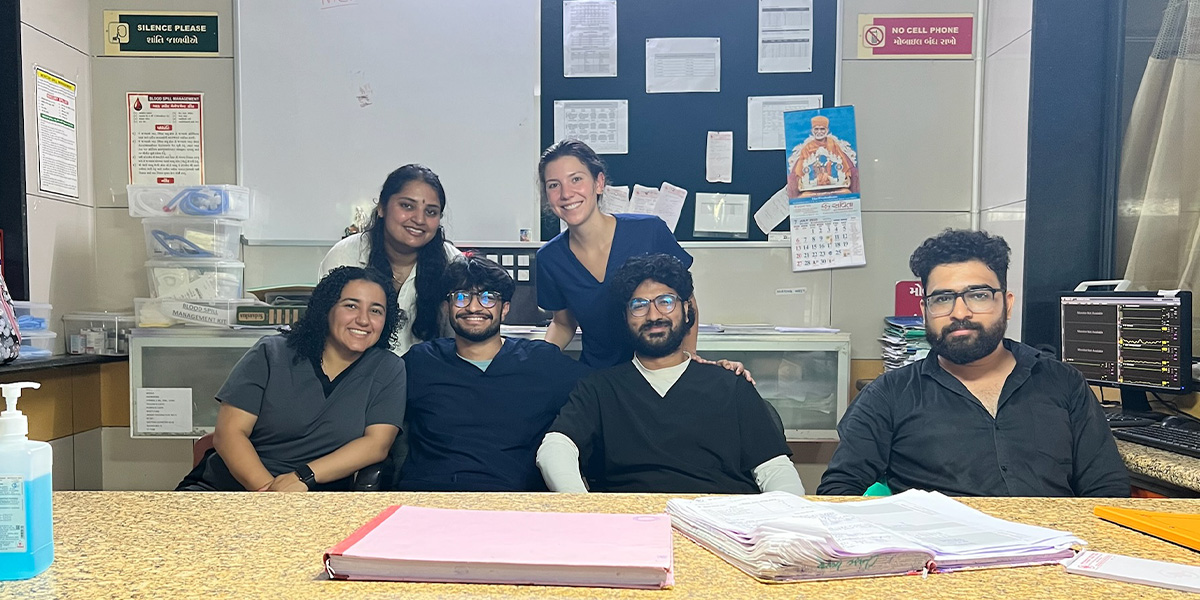
Student research spotlight: Mehraeel Saleh and Manav Patel
Third-year medical students Mehraeel Saleh and Manav Patel were among the more than 200 NEOMED students to present their scholarly work at the Student Research Symposium last fall. They shared with The Pulse the inspiration for their work, what they learned and next steps for research. The students worked together on two posters presented at the conference: “Effectiveness of a nutritional rehabilitation program for children with severe acute malnutrition in rural Gujarat, India” and “Organizational factors and barriers associated with care provision to children with malnutrition in rural India” The posters were based on research conducted in India in summer 2025. The pair spent a month in Gujarat, India, as part of the NEOMED Global Health program, under the supervision of program director Bernhard Fassl, M.D., and two physicians in Gujarat.
You both went to Baldwin-Wallace University together and have done projects together before. How did you end up working together on this project?
Manav Patel (MP): We were given the opportunity to go to India as part of the NEOMED global health program. My family is from India, and I was lucky enough to be in the same state [Gujarat] about two hours away from the city that my parents and their siblings are from. So this was a perfect opportunity to see my family. I got to see my grandmother, got a little bit of a family reunion in and got some valuable international healthcare experience.
I think it's important to understand where U.S. healthcare stands in relation to the rest of the world. I saw all of these “pros” to going and I didn't see many “cons” except that I didn’t want to go alone. I told Mehraeel about it, and we were like, okay, let's go!
Mehraeel Saleh (MS): I'm from Egypt and I grew up there for the first 12 years of my life, and if it wasn't going to Africa that summer [2025], I thought India would be also great. I wanted to see the hospital system, how things work there, get culturally competent. That was huge.
What led you to this particular topic?
MS: We were public health majors [at B-W]. I would like to continue doing public health-related work, even in my career as a physician. Something that also interests me is women's health, especially maternity health. It’s a huge public health problem. A lot of my projects in undergrad were in Cleveland, and we saw a lot of disparities there depending on the zip code. They're really trying to change that. And that was something that interested me in India, because we looked at the effect of nutrition and anemia in kids, but we also worked in the OB/GYN rotation there.
MP: We were given a couple different choices and out of the choices, this one most interested me because it brought together multiple, moving parts of the healthcare system. It wasn't just medically related. It was brought together the food system, transportation, all the social determinants of health. So I was able to do more research on that and actually use my undergrad degree in the fashion that it was meant to be used in. Bringing together research and past experience and cultural competency, understanding the way the nation is run, especially how the state is run. The project brought together all those sorts of topics to understand, learn and research, so it gave me a better understanding of how ecosystems and social norms work.
What are the details of the project that you presented?
MP: The first part of the research was determining how effective the childhood malnutrition treatment center at the hospital was over a period of time. There was an inpatient phase and an outpatient phase. We collected data and analyzed the health progression or the hospital course of the children when they're inpatient compared to outpatient. After that we decided to look at the barriers—socioeconomic barriers and environmental barriers—to delivering care. We realized that a lot of the children were getting great care while in the hospital. However, during follow up, there were a lot of factors that affected the progression of the children afterwards. We wanted to identify those and present those to the hospital to give them a better understanding of why children are not getting better in that area.
What were some of the things that you found? What were your key findings?
MS: Manav touched on transportation. A lot of the kids we saw were [migrant] farmers’ kids. Basically, their parents were getting employment in the area, but then we lost them to follow up because they would go from one area to the next. That was one thing.
Health literacy was also an issue. For instance, what's anemia or what nutrition do the kids need in the first few years of life?
MP: This is a very rural hospital. It was situated about an hour from the closest large city. It was a community-level hospital, and it was the only one in the county. So another point about the transportation is for patients who don't have enough money to own a car, motorcycle or a dependable method of transportation, they can't get to the hospital. Infrastructure is quite low there, especially in rural areas compared to the cities. In the rural areas it's not very dependable and neither is a weather, especially at the time we went. We were there during the monsoon season, the super rainy season when floods can happen out of anywhere. There were multiple days when nobody showed up to the clinic because the roads were completely flooded.
And health education, that was definitely an issue. A lot of the people we served never went to school past third grade. They're highly dependent on what little wages that they get. Going to the hospital means money out of their pockets and time out of their days. They would much rather just try to make money than go to the hospital and get care that they don't think that they need.
Do you see any broader implications of this research? Is this something you could apply with an urban population in downtown Akron or Cleveland?
MS: Food insecurity is something that you see a lot. Even at NEOMED, I think there's food insecurity that we may not be talking about. In Berea, it's huge but a little bit more silent than in areas in the cities. You can just see it more in the area we were in [in India]. So I think a system where food is not the issue, where it's just a human right, would be something to see.
Following up with a patient who's anemic in Akron or in a city would be easier to see their anemia level every couple of months. That’s a very common blood work.
MP: All the social determinants of health that we looked at—economics, education and wealth, and then access to healthcare—all of those are quite similar here as they are there in rural India. We see such a lack of healthcare. That's why hospitals try to attract doctors to rural areas because there's just such a lack of healthcare.
With the ongoing politics, I also think that getting healthcare in rural areas is much more difficult. The doctors that we were working with were dealing with funding cuts and they had a lot of issues keeping doctors in the rural areas.
I think from the people's perspective, the patient’s perspective, many people live in poverty, have the same sort of worries that they don't have enough money to pay for rent, they don't have enough money to pay for healthcare. They don't have enough money to just live a healthy life. So people there are worrying about taking time away from making money to go to the hospital. And I know people here definitely do too.
Is this an area that you think you'll continue to study?
MP: Absolutely. I definitely have an interest in understanding the intersection between the social determinants of health and actual healthcare. It makes me very happy to understand where bridges are missing and where access is missing so that solutions can be found. I do hope to do this in an urban setting. This was a rural setting, and those are two quite different areas, but the principles stay similar.
MS: I think that's something that I will continue to look at, especially global health and seeing as a physician how the social determinants of health affect healthcare. I think we can work with social workers here or nonprofits around us, anybody who is invested into just helping the general well-being of people, can really be an asset to the physician and getting people connected to the right places.
I also plan on working somewhere in Egypt sometime.
MP: I'm definitely interested in going into global health as well. I seem to have found a small place in India that I hope to go back to.
Do you have specific plans on what specialty you're going to pursue?
MP: Yes. I hope to specialize in internal medicine. I'm not exactly sure what I want to do specifically, but internal medicine is a hope for now. I also have interest in radiology and anesthesia, but I think IM is my top choice for now.
MS: I would say internal medicine also for now, but that could possibly change.
Is there anything else you’d like to add?
MP: I would suggest for people to go on as many global health trips as they can or even public health trips around the U.S., where they are able to connect with different populations and different people and challenge their own perspectives. Because medicine is all about serving others.
MS: I want to second that, especially going and meeting new people and people who look different than you, who might have different ways of living. You're going to see a lot of different people in your hospital setting. You don't know who's going to walk through the door.