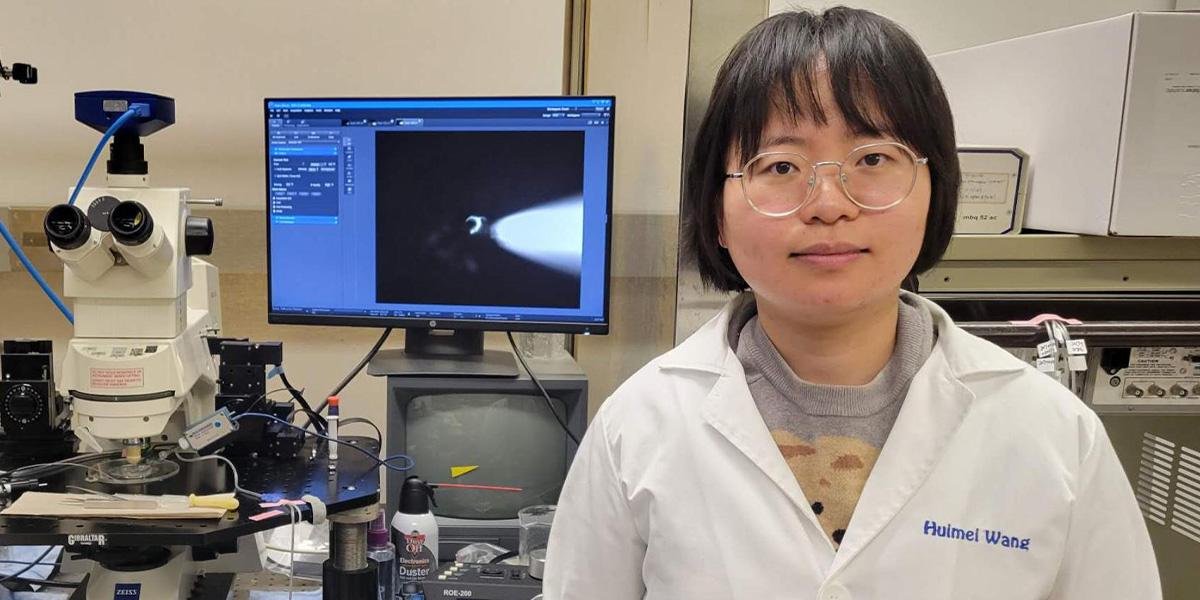
Voneida Neuroscience Research and Training Award helps student enhance her skills
Congratulations to Huimei Wang, the 2025 award recipient from the Ted and Swanny Voneida Neuroscience Research and Training Fund.
The award was established in 2020 through a gift from Swanny Voneida, whose late husband, Theodore “Ted” Voneida, Ph.D., was the founding chair of NEOMED’s Department of Neurobiology in the 1970s. The award from the Voneida fund provides extramural training opportunities for Ph.D. candidates and postdoctoral fellows in neuroscience at NEOMED.
“The Voneida Award is a great opportunity for graduate students and postdocs in neuroscience. They learn cutting edge techniques that will advance their careers in research,” noted Jeffrey Wenstrup, Ph.D., professor of biomedical sciences, who chairs the selection committee.
ENHANCING SKILLS
For one week in April, Wang worked in the lab of Hai Huang, Ph.D., at Tulane University, where she participated in a hands-on calyx patch-clamping training program which is directly related to her thesis.
“I joined the training to strengthen my lab skills and gain a deeper understanding of the calyx’s role in sound processing,” Wang shared. “Before the training, I had studied relevant research papers and communicated with Dr. Huang’s team online, but I continued to face challenges in my experiments due to the difficulty of identifying the patchable calyx and maintaining its health during recordings. I went to Dr. Huang’s lab to learn how to more accurately locate and patch these structures. On the first day, Dr. Huang introduced me to their research and lab equipment, which gave me valuable insight into how a high-functioning electrophysiology lab is set up. The following day, I observed a full day of experiments conducted by a lab member and noticed their brain slices appeared significantly healthier than ours. I learned that they used a different slicing solution and much lower air pressure during patching. I spent the rest of the week practicing these new techniques and working on independently identifying the calyx.”
Wang is currently a second-year graduate student enrolled in a joint program between NEOMED and Kent State University. She has worked in the lab of Yong Lu, Ph.D., professor of biomedical sciences, for about four years.
“Dr. Lu is an extremely supportive advisor, and under his guidance, I successfully completed my candidacy exam and prospectus last year. At this stage, I have only my final defense remaining before graduation. As I work to complete my thesis, I am facing a significant technical challenge involving patch-clamping the calyx of Held—a specialized presynaptic terminal in the auditory brainstem,” Wang noted.
“Being supported by the Ted and Swanny Voneida Neuroscience Research and Training Fund, Huimei was able to travel to New Orleans and learn an electrophysiological recording technique (patch clamp recording from a large presynaptic neuronal terminal in brain slices) from the experts in Dr. Hai Huang's lab at Tulane University,” Dr. Lu said. “The technique has been used to study mechanisms of neuronal communications for decades, yet it is so challenging that only a handful of laboratories in the world can perform it well. With her talents and great help from Dr. Huang's team, Huimei mastered the critical procedures of the technique during her training at Tulane University. Now she is able to reproduce the technique successfully in our own lab. This represents a milestone achievement that will not only facilitate the completion of Huimei's Ph.D. thesis, but will expand my lab's technical scope that allows us to tackle auditory neuroscience questions at a higher level.”
Wang also noted the immediate impact of her newfound skills.
“When I returned to my lab at NEOMED, I applied the methods I had learned at Tulane and saw significant improvements,” Wang shared. “The cells stayed in place more reliably, and I was able to obtain more successful recordings. This experience greatly improved my ability to troubleshoot during experiments and gave me a new perspective on my research. It also helped our lab operate more efficiently and effectively. Overcoming these technical challenges has been crucial in preparing for my defense and completing my thesis.”
LOOKING AHEAD
Wang shared her goals for the future:
“My short-term goal: After graduation, I aim to secure a postdoctoral position where I can further develop my research skills, as well as improve my abilities in scientific writing and grant applications,” she said.
“My long-term goal is to become an independent neuroscientist and establish my own research group at a university or research institution. I aspire to lead studies on the development and plasticity of the auditory system. By gaining a deeper understanding of these processes, I hope to contribute to better treatments and therapies for patients with hearing impairments. This goal is especially meaningful to me because I previously worked as a hearing and speech therapist in China,” she added.
FINAL THOUGHTS
“I would like to sincerely thank Dr. Hai Huang and his lab team for their generosity, patience, and instruction. Their input has been transformative to my development. I also gratefully acknowledge the Voneida Neuroscience Research and Training Fund for financial support,” she said.
THE COMMITTEE
The 2025 Voneida Fund Committee includes Jeffrey Wenstrup, Ph.D., professor of biomedical sciences (chair), Bohdan Chopko, M.D. (‘93), Ph.D., professor of biomedical sciences, and Sheila Fleming, Ph.D., associate professor of pharmaceutical sciences.